Art & Architecture
Click here for a video tour of St. John's history and buildings.
The people of St. John's
are blessed to worship in historic Olde Towne Portsmouth, surrounded by reminders of our history as a city, a nation, and a Christian church. Our Gothic building, constructed of rose granite from Salisbury, North Carolina, was opened for worship in September, 1898. The worship space within is rich with images and symbols that affirm and feed our faith.
In the tradition of western church architecture, our worship space is cruciform, shaped like a cross. The upright of the cross, where the congregation sits, is traditionally called the nave because the high wooden ceiling is shaped like the keel of a ship. The crossbeam, or transept, of the worship space houses our contemporary musicians on one side of the nave and the Founders' Chapel, dedicated on the Feast of St. John 2011, on the other.
Above the Washington Street entrances
 is a magnificent rose window. At its heart, the Lamb Triumphant represents Christ, within an eight-lobed flower. Surrounding the Lamb are eight circles, each containing a Christian symbol—the four evangelists represented by the four living creatures, the Greek letters Alpha and Omega intertwined, the Greek monogram for Jesus, the dove for the Holy Spirit and a grapevine for the blood of Christ. The number eight, a sign of the resurrection of Jesus, is used repeatedly in the geometry of this rose window. At its most basic, the rose window is a circle, with no beginning and no end, the perfect symbol of God.
 At the opposite end of the worship space—in the chancel—the glorious Watts memorial Tiffany altar window overlooks the altar and reredos (screen behind the altar) made of marble. These were designed by Mary Brown Channel, the first female licensed architect in Virginia, and daughter of Bishop William A. Brown of Southern Virginia, who served as Rector of St. John’s from 1904-1938. The altar window depicts Jesus with his arms outstretched in invitation to all. Frederick Wilson, the premier designer at Tiffany, was known for his painting of refined facial features. Made from Tiffany’s favrile glass and installed in 1907, this window is a resplendent beacon above the altar. The simplicity of the design is powerful, and it is easily the most commanding presence in this church full of beautiful windows.
In 1750 Colonel William Crawford
laid off the town of Portsmouth on the west bank of the Elizabeth River. The Parish Church was erected on the church square in 1762 and became known as Trinity Church.
In 1848, theological differences over baptism and the authority of the priest led vestry members and parishioners of Trinity Church, with the blessing of the bishop, to create a new congregation: St. John’s.
 The original building, a plain brick structure with Doric columns, was completed in 1850 and was located at the corner of Court and London Streets. Three items from that structure—the Constitution Baptismal Font, the “All Seats Free” Cruciform Brass entrance sign and the Chisholm Wall Momument, dedicated to the parish’s first priest and rector who lost his life ministering during the Yellow Fever Epidemic of 1855—were moved to the current worship space when it was completed in 1898.
More parish history can be found here.

The Constitution Baptismal Font
is now located in the Founders’ Chapel. It was fashioned from a live oak pillar taken from the celebrated War of 1812 frigate, USS Constitution, then under repair at the Gosport US Navy Yard in Portsmouth (now called Norfolk Naval Shipyard). Commodore Lewis Warrington, then a member of the congregation, presented the font to St. John’s Church. This font’s location, along with the newer stone font at the main entrance of the church, allow those who enter and leave our worship space to use holy water to remind them of their new life in Christ through the gift of Baptism. The interior water basins were created by Daniel Christie, an award-winning Virginia potter.
The Constitution Baptismal Font rests on a curly maple and walnut table that matches the Founders’ Chapel Altar Table. Into the design of both tables artist Andy Perkins of St. John’s Parish incorporated the curves of the chapel arches. Also present in the Founders’ Chapel is a marble wall monument to the parish’s founders, an Orthodox prayer candle sand tray created by Chris Austin of St. John’s Parish, and the King of Glory icon.
The King of Glory Icon
depicts the crucifixion of Christ with the Blessed Virgin Mary and the Beloved Disciple John standing at the foot of the cross. Appearing prominently above the Founders' Chapel altar and and at the top left of this website, it was written (painted) in 2012 by award-winning iconographer Irene Perez Omer in the ancient 15th century icon-writing technique of egg-tempera on solid wood panels. Because the icon is a Holy Image, it contains nothing synthetic or artificial. Only pure and natural materials are chosen for the writing of the icon. The materials include solid wood board, linen fabric, natural gesso and glues, clay, 24-carat gold leaf, natural ground and raw pigments, eggs and water.
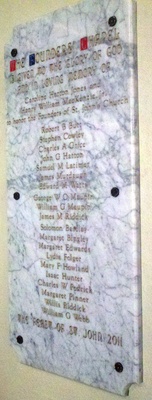 The Founders’ Chapel wall monument
 The Founders’ Chapel wall monument
is the last planned for the nave of St. John’s worship space. Carved by Ogg Stone Works, a Portsmouth Stone Company founded in 1896, it is a fitting and lasting testimonial to those pioneering souls whose tenacity and courage planted this vibrant parish. In addition to carving this wall monument, Ogg Stone Works supplied the rose-colored North Carolina granite used for the exterior of our current worship space as well as the white marble used in other interior wall monuments.